
Langley & Brookswood BC · Sciatica & Lumbar Nerve Pain Treatment
Sciatica Pain Physiotherapy in Langley BC — Disc Herniation, Lumbar Radiculopathy & Nerve Pain Treatment
At Olive Physiotherapy & Sports Injury Clinic in Langley BC, CPTBC-registered physiotherapists identify the specific source of your sciatic nerve pain — whether a herniated disc at L4/5 or L5/S1, lumbar stenosis, piriformis syndrome, or sacroiliac dysfunction — and deliver evidence-based treatment that targets the nerve root directly. Serving Langley, Aldergrove, Clayton Heights, Cloverdale, Murrayville, and Willoughby.
- ✓Expert physiotherapy, RMT & acupuncture — integrated sciatica care in Langley
- ✓ICBC MVA sciatica & lumbar nerve injuries — $0 patient fee
- ✓WorkSafeBC occupational disc & nerve injuries — direct billing for approved claims
- ✓Disc herniation · Lumbar radiculopathy · Piriformis syndrome · Spinal stenosis
- ✓Same-week appointments — Langley, Aldergrove, Willoughby, Brookswood, Cloverdale
- ✓No physician referral required — call or book online today
What Is Sciatica — and How Does Physiotherapy Treat It in Langley?
Sciatica is not a diagnosis — it is a symptom pattern describing pain, numbness, tingling, or weakness that radiates along the course of the sciatic nerve from the lower back through the buttock and down one leg. The term 'sciatica' therefore describes where the pain goes, not what is causing it. Identifying the underlying cause is essential — because the treatment for a herniated disc at L5/S1 differs substantially from piriformis syndrome, sacroiliac joint referral, or lumbar spinal stenosis.
The most common cause of true sciatica is a herniated intervertebral disc — most frequently at L4/5 or L5/S1 — compressing or irritating the L4, L5, or S1 nerve roots that form the sciatic nerve. Consequently, at Olive Clinic in Langley, every sciatica assessment includes a detailed neurological examination — dermatomal sensation testing, myotomal strength testing, reflexes, neural tension tests — to identify the specific nerve root involved and guide treatment precisely.
MVA-related lumbar disc injuries and sciatica are covered under ICBC Enhanced Care — billed directly at $0. Occupational disc and nerve injuries are covered under WorkSafeBC. See also our work injury rehab and MVA rehab pages.
Clinical evidence:
A 2021 Cochrane Review of lumbar disc herniation and sciatica found that physiotherapy — combining neural mobilization, spinal manual therapy, and progressive exercise — produced clinically significant reductions in leg pain and disability compared to usual care, without the risks associated with surgical intervention. Surgery was superior only in the first 8–12 weeks for severe presentations; long-term outcomes were equivalent.
Sciatica & Lumbar Nerve Conditions Treated
Disc Herniation Sciatica (L4/L5/S1)
Herniated nucleus pulposus compressing a lumbar nerve root — the most common cause of true sciatica.
Lumbar Radiculopathy
Nerve root irritation producing dermatomal leg pain, numbness, or weakness — from disc, bone, or stenosis.
Piriformis Syndrome
Sciatic nerve compression by the piriformis muscle in the deep gluteal space — mimics disc sciatica.
Spinal Stenosis
Central or foraminal narrowing compressing nerve roots — bilateral leg symptoms, worse with walking.
Sacroiliac Joint Referral
SIJ dysfunction producing buttock and posterior thigh pain — frequently misdiagnosed as sciatica.
MVA Lumbar Disc Injury — ICBC
Disc herniation from MVA collision forces — covered under ICBC Enhanced Care at $0.
Occupational Disc Injury — WorkSafe
Lifting and heavy manual work disc injuries — WorkSafeBC covered for approved claims.
Post-Surgical Sciatica Rehab
Structured rehabilitation following discectomy, laminectomy, or spinal fusion.
Which Nerve Root Is Causing Your Sciatica? — Dermatomal Guide
The location of leg pain, numbness, and weakness provides precise information about which lumbar nerve root is involved. At Olive Clinic in Langley, this dermatomal mapping guides the assessment and directs treatment to the correct spinal level.
L4 Nerve Root
L3/4 Disc Herniation
Pain: Anterior thigh, medial knee, medial shin
Numbness: Medial shin and foot
Weakness: Knee extension (quadriceps)
Reflex: Reduced knee jerk
L5 Nerve Root
L4/5 Disc Herniation — Most Common
Pain: Outer hip, lateral thigh, lateral shin to dorsum of foot
Numbness: Lateral shin, first and second toe
Weakness: Big toe and foot dorsiflexion
Reflex: No consistent reflex change
S1 Nerve Root
L5/S1 Disc Herniation — Most Common
Pain: Posterior thigh, posterior calf, lateral foot and heel
Numbness: Lateral foot, little toe
Weakness: Plantarflexion, calf
Reflex: Reduced ankle jerk
Dermatomal patterns overlap and vary between individuals. Clinical examination at Olive Clinic in Langley confirms the nerve root level before treatment begins.
Sciatica & Nerve Pain — Three Disciplines at Olive Clinic Langley
Sciatica has both a structural source (disc, bone, muscle) and a neuropathic pain component. Consequently, effective treatment addresses both simultaneously. Physiotherapy, RMT, and acupuncture each target a distinct dimension. See all services →
Physiotherapy
CPTBC-registered physiotherapists apply neural mobilization (sciatic nerve flossing and tensioning), lumbar spinal mobilization and manipulation, McKenzie directional preference exercises, progressive lumbar stabilization, and traction techniques — all targeted to the specific nerve root and disc level identified in your neurological assessment.
ICBC MVA · WorkSafe · Direct billing · $0 for qualifying claims
Registered Massage Therapy
CMTBC-registered RMTs address the muscular contributors to sciatic nerve irritation — releasing piriformis muscle tension that can compress the nerve in the deep gluteal space, lumbar paraspinal hypertonicity that increases disc loading, and hamstring tightness that amplifies neural tension and restricts straight leg raise.
ICBC RMT · Direct billing · Extended health covered
Acupuncture
CTCMA-registered acupuncturists provide medical acupuncture for the neuropathic pain component of sciatica — modulating central sensitization, reducing neurogenic inflammation along the sciatic nerve pathway, and addressing the chronic pain patterns that persist after the acute disc event has resolved.
ICBC acupuncture · Direct billing available
ICBC MVA lumbar disc & sciatica — $0 patient fee, billed directly. All direct billing insurers →
📅 Book Sciatica AssessmentSciatica Treatment Techniques at Olive Physiotherapy Langley
Every sciatica presentation is different. The specific nerve root, the causative structure, and the pain mechanism all determine which treatments are applied. Treatment begins at your first appointment.
Neural Mobilization — Sciatic Nerve Flossing & Tensioning
Progressive neural mobilization techniques — nerve flossing (alternating tension and slack) and nerve tensioning (sustained tension) — reduce intraneural inflammation, improve axoplasmic flow, and desensitize the irritated sciatic nerve. Neural mobilization is supported by strong evidence for lumbar radiculopathy and is typically painless when performed correctly.
Lumbar Manual Therapy & Mobilization
Graded lumbar joint mobilization and manipulation — including traction mobilization — reduces nerve root compression, restores segmental mobility, and produces immediate neurophysiological pain relief. Mulligan and McKenzie approaches are integrated based on the directional preference identified in your assessment.
McKenzie Method & Directional Preference Exercise
The McKenzie method identifies the specific movement direction that centralizes or abolishes your leg pain — typically lumbar extension for posterior disc herniations. Repeated movements in the directional preference position progressively reduce nerve root compression and are prescribed as an independent home exercise program from session one.
Dry Needling / IMS
IMS of lumbar paraspinal muscles, gluteus medius, piriformis, and hamstring trigger points releases chronic muscle hypertonicity that increases lumbar disc loading, compresses the sciatic nerve in the deep gluteal space (piriformis syndrome), and amplifies neural tension through restricted hip and hamstring flexibility.
Laser Therapy
Low-level laser applied to the lumbar nerve root exits and along the sciatic nerve pathway reduces periradicular inflammation and promotes nerve healing — particularly effective for the chronic burning, aching component of neuropathic sciatica pain that persists beyond the acute disc event.
Lumbar Stabilization & Progressive Exercise
Progressive lumbar stabilization — transversus abdominis, multifidus, and hip musculature — reduces mechanical loading on the lumbar discs and nerve roots. Coordinated with kinesiology for gym-based progressive conditioning once acute nerve irritation has settled.
Serving: Langley City · Aldergrove · Clayton Heights · Cloverdale (Surrey) · Brookswood · Willoughby · Murrayville · Downtown Langley. Affordable physiotherapy options available →
Framework A — Outcome-Driven Authority
Clinically Proven Sciatica Relief — Neural Mobilization, Disc Rehab & Nerve Root Treatment at Olive Physiotherapy Langley
Our experienced CPTBC-registered physiotherapists have helped hundreds of patients across Langley, Aldergrove, Willoughby, and Cloverdale recover from sciatica, disc herniation, and lumbar radiculopathy — using evidence-based neural mobilization, McKenzie directional preference, and lumbar manual therapy. ICBC and WorkSafe billed directly at $0.
Framework B — Pain-Point Emotional Hook
Electric Shooting Pain Down Your Leg? Can't Sit, Stand, or Sleep Without Sciatic Pain? There Is a Better Answer Than Waiting It Out.
If sciatica is stopping you from working on a Langley construction site, sitting through your commute from Cloverdale, or sleeping through the night in Willoughby — Olive Clinic has helped patients just like you get off the couch and back to life with targeted nerve root and disc rehabilitation. ICBC and WorkSafe: $0 cost, billed directly.
A/B test: toggle display between .ab-variant-a and .ab-variant-b via Nelio A/B Testing. Conversion goal: tel: click and Jane App interaction.
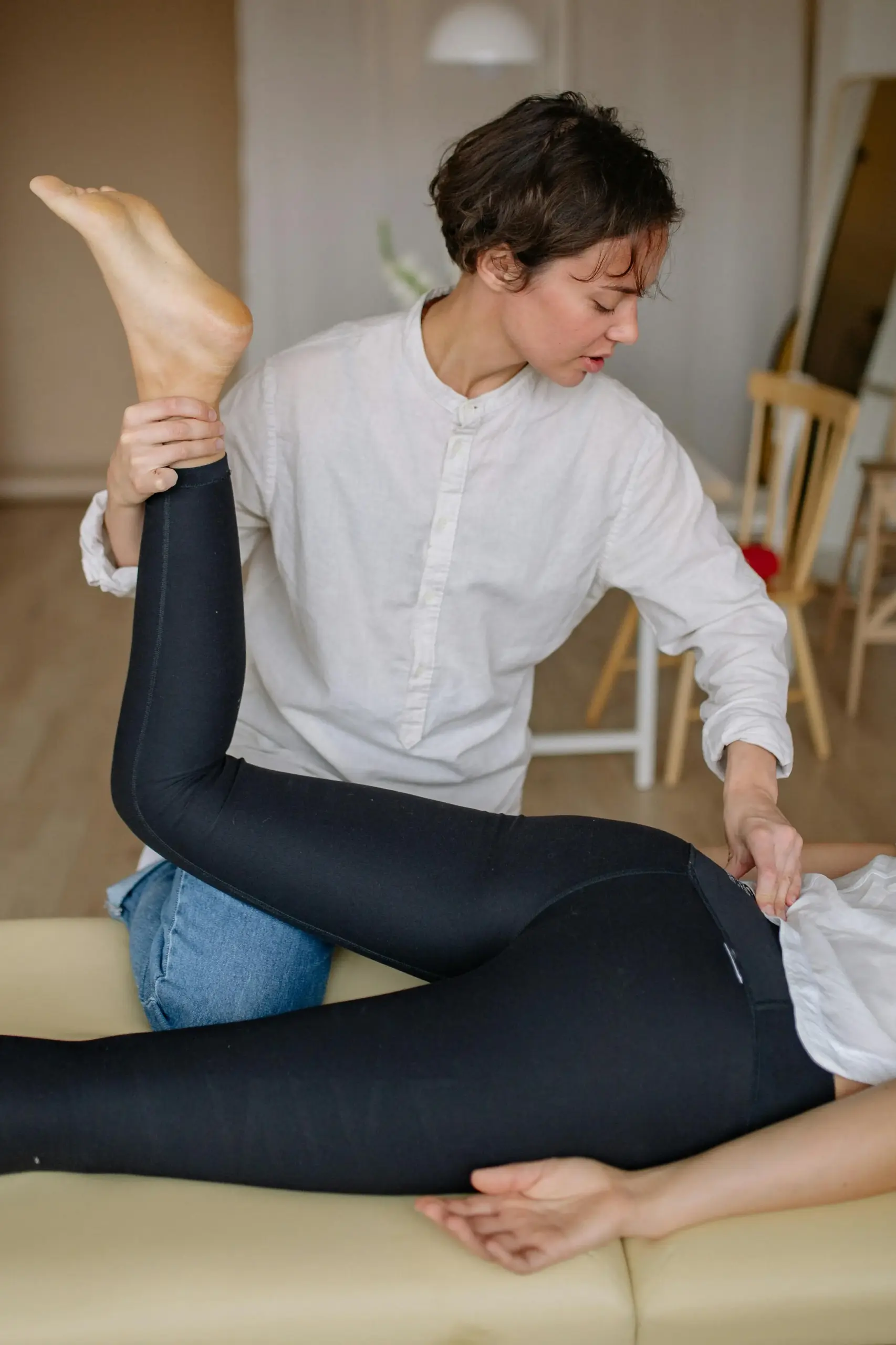
Your Sciatica Assessment at Olive Clinic — What to Expect
Neurological Assessment
Dermatomal sensation testing, myotomal strength testing, deep tendon reflexes, straight leg raise, slump test, and femoral nerve tension test — identifying the specific nerve root involved and the severity of compression.
Source Identification & Treatment Plan
Your physiotherapist explains the likely causative structure — disc, piriformis, stenosis, or SIJ — and outlines a treatment plan with realistic milestones and a clear recovery timeline.
Neural Mobilization Begins in Session One
Sciatic nerve flossing, McKenzie directional exercises, and lumbar mobilization begin immediately — you leave with a home neural mobilization program proven to reduce nerve root irritation between sessions.
Progressive Decompression & Stabilization
As nerve irritability settles, progressive lumbar stabilization, disc loading management, and functional conditioning systematically restore full movement and prevent recurrence.
ICBC or WorkSafe Billing Handled Entirely
For MVA or occupational disc and nerve injuries, all paperwork and claim billing are managed by Olive Clinic — $0 out-of-pocket for qualifying claims.
Related Services & Resources at Olive Physiotherapy Langley
Sciatica Physiotherapy FAQ — Langley, Aldergrove & Brookswood BC
Common questions about sciatica treatment at Olive Clinic. Call 672-888-0077 if your question isn’t here.
What is the difference between sciatica and referred back pain?
Do I need surgery for a herniated disc causing sciatica?
Is my sciatica from an MVA covered by ICBC?
Is occupational sciatica covered by WorkSafeBC?
What is piriformis syndrome and how is it different from disc sciatica?
How long does sciatica take to resolve with physiotherapy?
What are the warning signs of serious sciatica requiring emergency assessment?
Can acupuncture help sciatica?
Does Olive Clinic offer direct billing for sciatica physiotherapy in Langley?
What is the McKenzie method and why is it used for sciatica?
More From Olive Physiotherapy — Langley BC
Your Takeaway — Start Your Sciatica Recovery in Langley This Week
At Olive Physiotherapy & Sports Injury Clinic in Langley BC, our experienced registered therapists have helped hundreds of patients across Langley, Aldergrove, Clayton Heights, Cloverdale, Brookswood, Willoughby, Murrayville, and Downtown Langley City recover from sciatica and lumbar nerve pain — many of whom had been managing debilitating leg pain for months without a clear diagnosis or effective treatment plan.
Whether your sciatica is from a car accident, a lifting injury at work, a herniated disc from sport, or years of cumulative disc loading — we are ready to assess your specific nerve root, identify the source, and build a targeted rehabilitation plan that actually addresses the cause. Book with one of our experienced therapists today at olivephysio.ca/book-now/
- ✔ICBC MVA sciatica & disc injuries — $0 patient fee, billed directly
- ✔WorkSafeBC occupational disc & nerve injuries — $0 for approved claims
- ✔Direct billing: Pacific Blue Cross · Sun Life · Manulife · Canada Life & more
- ✔Same-week appointments — Langley, Aldergrove, Willoughby, Brookswood, Cloverdale
- ✔Physiotherapy · RMT · Acupuncture — all coordinated under one roof
- ✔No physician referral required — call or book online today
Book Your Sciatica Assessment
ICBC claim? WorkSafe? Just bring it — we handle all billing
Expertise You Can Trust — Regulated Health Professionals in Langley
CPTBC Registered
All physiotherapists are registered with the College of Physical Therapists of BC — regulated health professionals.
CMTBC Registered
RMTs are registered with the College of Massage Therapists of BC — meeting all insurer credentialing requirements.
CTCMA Registered
Acupuncturists are registered with the College of TCM Practitioners & Acupuncturists of BC.
ICBC Authorized
Olive Clinic is an ICBC Authorized Provider — disc and nerve injuries from MVAs billed directly at $0.